
In Japan, there is a tradition called, Tango no Sekku, aka Boys' Day (also known as Feast of Banners) while Girls' Day (Hinamatsuri) was celebrated on March 3. In 1948, the government decreed this day to be a national holiday to celebrate the happiness of all children and to express gratitude toward mothers. It was renamed Kodomo no Hi..
Before this day, families raise the carp-shaped koinobori flags (carp because of the Chinese legend that a carp that swims upstream becomes a dragon, and the way the flags blow in the wind looks like they are swimming), one for each boy (or child), display a Kintarō doll usually riding on a large carp, and the traditional Japanese military helmet, kabuto. Kintarō and the kabuto are symbols of a strong and healthy boy.
Kintarō is the childhood name of Sakata no Kintoki who was a hero in the Heian period, a subordinate samurai of Minamoto no Raikou, having been famous for his strength when he was a child. It is said that Kintarō rode a bear, instead of a horse, and played with animals in the mountains when he was a young boy.
Mochirice cakes wrapped in kashiwa (oak) leaves — kashiwa-mochi (just like regular mochi, but is also filled with red beans jam) and chimaki (a kind of "sweet rice paste," wrapped in an iris or bamboo leaf) — are traditionally served on this day.
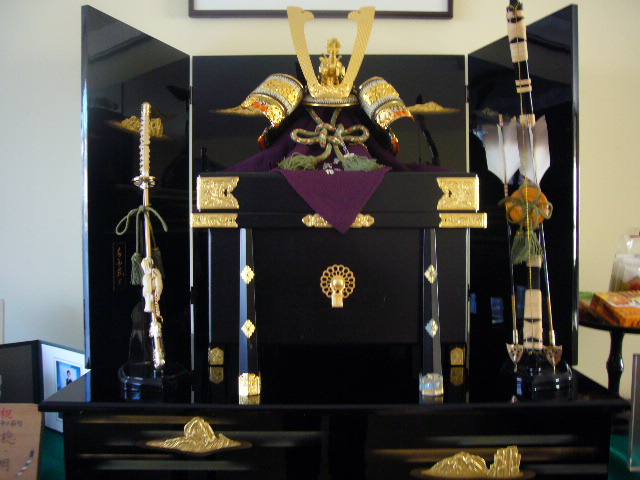
The traditional Japanese military helmet, kabuto.
The Japanese sword「katana」
The bow and arrow「yumiya」
